
Family and Proper White
Womanhood
The concept of "proper" white womanhood was deeply tied to upholding the social construct of the "Normal Family" (McWhorter, 2009). White women were expected to embrace domesticity, submissiveness, and reproductive duty to preserve racial purity and uphold traditional gender norms. Their roles centred on caregiving, nurturing, homemaking, and moral stewardship, reinforcing the gender binary and ensuring children were also raised within the strict gender roles that aligned with patriarchal ideals essential for social stability (McWhorter, 2009). Any deviation from these norms, such as gender deviance or homosexuality were seen as a threat to the nation (McWhorter, 2009). These gender expectations were not only about family structure but also about controlling bodies. Women were also expected to remain thin, dainty, and demure further reinforcing ideals of discipline, purity, and civilization (Farrell, 2011).
Popenoe, or “Mr. Marriage”, emphasized marriage and motherhood over education, discouraging women from professional ambitions and warning that feminism would severely harm future generations (McWhorter, 2009). Women sacrificed property rights, their right to choose their domicile, and their autonomy in marriage (McWhorter, 2009). It was assumed that women “should be content with themselves with their subordinate position within the institution of patriarchal marriage and their role as mothers to the next generation of genetic transport systems” (McWhorter, 2009, p. 264).

(Crockwell, n.d.)
This picture shows a 'proper' white woman baking in the kitchen while caring for her children. The little girl is learning gender norms and her future role while the little boy watches and does not participate.
Threats to Proper White Womanhood
The Feminist
Feminism is positioned as a direct challenge to the traditional gender roles that uphold the "Normal Family" (Farrell, 2011). Feminists were perceived as threats to national stability, accused of rejecting the family structure, undermining social order, and corrupting future generations through both genetics and ideology (McWhorter, 2009). Particularly threatening was the middle-class Nordic feminist, who defied expectations of domesticity and instead pursued autonomy, education, and liberation from patriarchal control risking the continued of the reproduction of the white race (McWhorter, 2009).
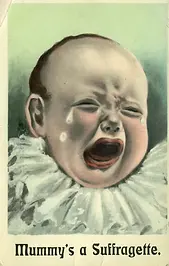

This picture shows a crying baby because their "Mummy is a Suffragette" and is not longer caring for the child.
This picture displays angry women, many unattractive with buck teeth, fighting for the right for women to vote. The caption implies that the women suffragettes (or feminists) are plain, dumb, and unattractive.

Contemporary White Womanhood
Click on the buttons below to read more!
Here are some additional resources:
In this brief video, Sabrina Strings connects racism and fat stigma. She also discusses the medical field's Body Mass Index (BMI) and how it upholds racial and gender hierarchies by promoting white, thin bodies as the ideal while stigmatizing fatness, especially in women of colour.
This article discusses how feminism has traditionally centred the experiences of white women, losing its transformative potential when race intersects with gender. The authors advocate for ideological intersectionality as a necessary corrective to this exclusionary framework.
This article dives into how diet culture intersects with gender roles, white womanhood, and racism. The authors argue that diet culture is tied to patriarchal control over women’s bodies and is underpinned by systemic and structural inequalities.

This article examines the emergence of the "tradwife" persona within the online "momosphere" which is a network of parenting, relationship, cooking, and crafting blogs and social media platforms. These self-identified tradwives advocate for a return to "traditional" gender roles, where men serve as providers and protectors, and women focus on child-rearing and domestic responsibilities. The author's analysis highlights how this movement intertwines with radicalized notions of domesticity, potentially reinforcing patriarchal and exclusionary ideologies.
Test Your Knowledge
Reflection Questions
Take a few moments and reflect on these questions and write your thoughts in a journal or notebook.
-
What did your family structure look like growing up? Did it ascribe to "proper" gender norms and roles?
-
What are negative traits that you hear in the media or from family and friends that describe feminists? Knowing what you know now, where do you think these descriptions stemmed from?
-
Can you think of examples of white benevolence and/or fat stigma and diet culture that you see in everyday life?

Summary
-
Proper white womanhood was historically constructed to uphold racial purity and traditional gender roles, emphasizing domesticity, submission, and moral stewardship. Any deviation, including gender nonconformity or homosexuality, was seen as a threat to national stability.
-
Women were discouraged from educational and professional ambitions, expected to sacrifice autonomy within marriage, and serve as reproductive vessels for the white race. Feminists were framed as threats to the social order.
-
Western beauty ideals have positioned thin white bodies as symbols of discipline and superiority, while fatness was stigmatized as excessive and primative. The BMI system reinforced this.
-
The #tradwife movement promotes a romanticized version of traditional gender roles. Through social media, tradwives monetize and glorify domesticity while spreading conservative values and white supremacy.
-
Feminism has historically centered on white women’s experiences while marginalizing women of color. White benevolence, disguised as help, reinforces white superiority by positioning white women as "saviors" of marginalized groups while avoiding accountability for systemic racism.
Designed and written by Jenna McDonald
References
Crockwell, D. (n.d.). Mother And Daughter Baking Together. Archive for the ‘CROCKWELL Douglass’ Category. photograph. Retrieved from https://americangallery.wordpress.com/category/crockwell-douglass/.
Farrell, A. E. (2011). Fat shame: Stigma and the fat body in American culture. New York University Press.
less
Gebhard, A., McLean, S., & St. Denis, V. (Eds.). (2022). White benevolence: Racism and colonial violence in the helping professions. Fernwood Publishing.
Jovanovski, N., & Jaeger, T. (2022). Demystifying ‘diet culture’: Exploring the meaning of diet culture in online ‘anti-diet’ feminist, fat activist, and Health Professional Communities. Women’s Studies International Forum, 90, 102558. https://doi.org/10.1016/j.wsif.2021.102558
McWhorter, L (2009). Racism and Sexual Oppression in Anglo-America: A Genealogy. Indiana University Press
Moon, D. G., & Holling, M. A. (2020). “white supremacy in Heels”: (white) feminism, white supremacy, and discursive violence. Communication and Critical/Cultural Studies, 17(2), 253–260. https://doi.org/10.1080/14791420.2020.1770819
Powell, S. (2017). Queer in the age of the queen: Gender and sexuality of the mid modern period in Victorian England and North America. Molly Brown House Museum. https://mollybrown.org/queer-in-the-age-of-the-queen-gender-and-sexuality-of-the-mid-modern-period-in-victorian-england-and-north-america/
Proctor, D. (2023). The #tradwife persona and the rise of radicalized domesticity. Persona Studies, 8(2), 7–26. https://doi.org/10.21153/psj2022vol8no2art1645
Strings, S. (2021). Sabrina Strings Explains How “Fatphobia” is Rooted in Racism. YouTube. https://www.youtube.com/watch?v=Z-dwCWGm_sY&t=1s